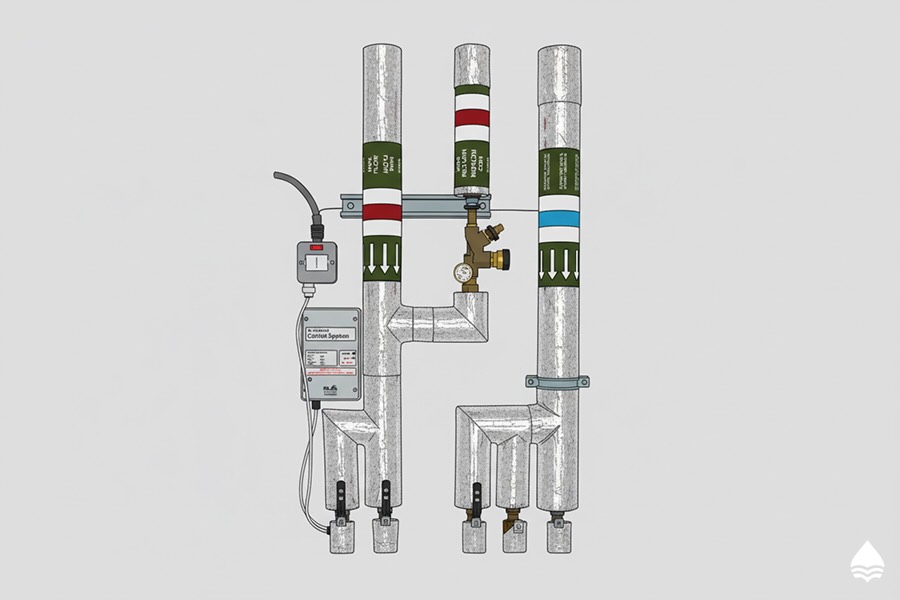
Hot water recirculating systems are essential for ensuring an immediate supply of hot water throughout large buildings, but they inherently carry a heightened Legionella risk. The very act of storing and recirculating water creates the potential for bacterial growth if control measures fail. For dutyholders and those responsible for premises, understanding and mitigating this specific risk is a mandatory legal duty under the Health and Safety at Work etc Act. Effective Legionella control hinges on maintaining a system that actively prevents conditions favourable for the bacteria's growth.
The Critical Danger Zone: Poor Temperature Control
The most effective, traditional control strategy for Legionella bacteria in hot water systems is temperature. The bacteria naturally occur in water sources but multiply rapidly when the temperature falls into the danger zone of 20°C to 45°C.
For a recirculating system, the primary Legionella risk arises when:
Storage Temperature Drops: Hot water should be stored at a minimum of 60°C in the calorifier. Failure of the heating element or poor thermostatic control can allow this storage temperature to drop, contaminating the supply.
Circulation Temperature Falls: The recirculating pump's job is to move hot water through the pipework constantly, preventing heat loss. If the pump fails, is undersized, or if pipework insulation is inadequate, the temperature of the water returning to the calorifier can drop below the minimum safe level. This allows the bacteria to proliferate throughout the entire circuit.
Stagnation and Poor Balance in Recirculating Loops
Even in a recirculating system, localised areas of stagnation are a major risk factor. These areas can occur due to poor hydraulic balancing or improper system design:
Poor Balancing: If the recirculating loop is not properly balanced, water will take the path of least resistance, leading to slow or non-existent flow in certain pipe sections. This results in temperature stratification and stagnation, where the water quickly cools into the danger zone.
Dead Legs and Dead Ends: These are pipe sections connected to the system but are no longer in use, or pipes serving infrequently used outlets. These stagnant sections collect sediment and scale, which provides nutrients for bacterial growth, and are extremely difficult to keep at safe temperatures.
Controlling these areas is essential for proper water treatment and preventing a Legionnaires' disease outbreak.
Mandatory Monitoring: In Line with HSG274 Part 2
To ensure effective Legionella control, all recirculating systems must be monitored as specified in the Health and Safety Executive's (HSE) HSG274 Part 2, the technical guidance for controlling Legionella in hot and cold water systems.
HSG274 Part 2 mandates specific temperature regimes for a safe system:
Storage Temperature: Hot water must be stored above 60°C.
Distribution Temperature: The water should reach a temperature of at least 50°C (or 55°C in healthcare premises) at the outlets within one minute of turning on the tap.
Recirculation Return Temperature: The guidance is explicit that the hot water circulating loop must be designed and monitored to achieve a return temperature to the calorifier of 50°C or above.
Subordinate loop Temperature: The guidance advises testing pipe temperatures of all subordinate loops at least quarterly to ensure they are maintained above 50°C.
Routine water system monitoring and inspection, which typically involves monthly checks of hot water temperatures, is required to demonstrate compliance and provide essential evidence that the control scheme is working. Failure to implement, manage, and monitor these precautions can lead to serious legal non-compliance.
Managing the Legionella risks in hot water recirculating systems requires more than a functioning boiler; it demands vigilance over temperature control, hydraulic balance, and adherence to regulatory standards like HSG274 Part 2. For dutyholders, an up-to-date and thorough Legionella risk assessment carried out by a competent person is the non-negotiable first step in creating a legally compliant control scheme.

Andrew Arnold
Co‑founder & Director
Andrew has over 20 years' experience in Legionella management and control. As a senior member of the Water Management Society and educated to masters level Andrew has extensive experience in legionella risk assessment of numerous systems and sectors.