Cooling Tower Legionella Control: Notification and the Basics
Cooling tower Legionella control rests on two things: notifying the local authority that the tower or evaporative condenser exists, and running a documented regime of water treatment, monitoring, cleaning and record keeping that keeps the system under safe operational control. Both are expected of anyone who has control of premises with one of these systems.
Evaporative cooling systems are among the highest-risk water systems a dutyholder can manage. This article explains the notification law, why these systems attract scrutiny, and the core control measures in HSG274 Part 1 (second edition, 2024).
Why Cooling Towers Carry a High Legionella Risk
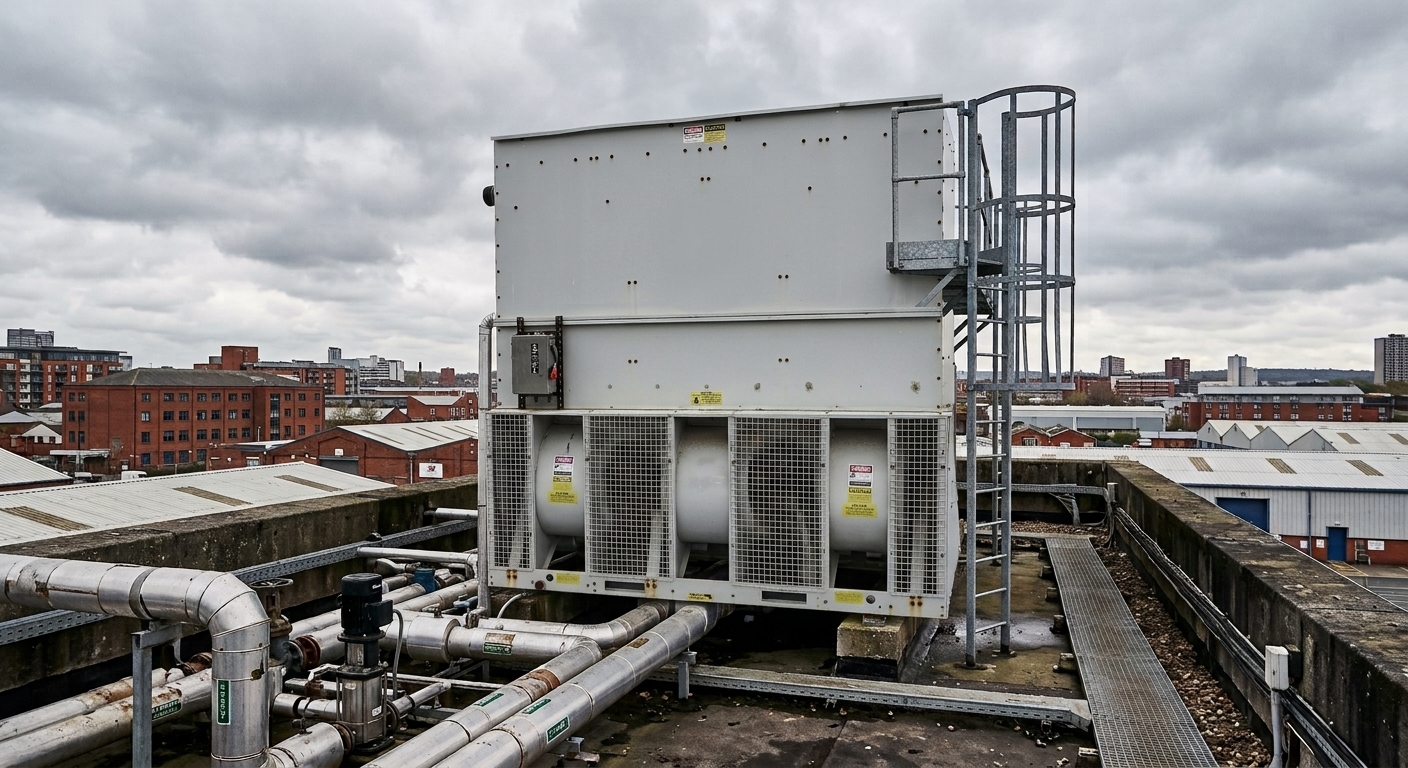
A cooling tower cools recirculating water by direct contact with a moving air stream; an evaporative condenser sprays water over a coil containing the fluid being cooled. In both cases the conditions suit Legionella: warm water, a constant supply of nutrients drawn in from the air, surfaces where biofilm and sediment build up, and a fan that pushes droplets out of the unit.
Those droplets, known as drift, can travel well beyond the site boundary. That is why cooling systems have been linked to large community outbreaks rather than cases confined to one building. The 2002 outbreak in Barrow-in-Furness, traced to the air-conditioning unit of a council-owned arts centre, led to 179 attributed cases and seven deaths. Outbreaks like this explain why inspectors look closely at evaporative cooling.
The Notification of Cooling Towers and Evaporative Condensers Regulations 1992
The Notification of Cooling Towers and Evaporative Condensers Regulations 1992 place a duty on each person who has, to any extent, control of non-domestic premises to make sure a notifiable device is not there unless it has been notified to the local authority. Notification is made in writing on an HSE-approved form, which most councils publish online.
The key points of the Regulations are:
What is notifiable: a cooling tower or evaporative condenser, unless it contains no water exposed to air, or its water supply or electrical supply is not connected.
What you provide: the address of the premises, contact details for a person in control, the number of notifiable devices and where each one is located on site.
Changes: any change to the notified details must be notified in writing within one month.
Decommissioning: when a device is no longer operational and is not intended to become operational again, the local authority must be told as soon as reasonably practicable.
Temporary shutdowns: no cessation notice is needed when operation is suspended for maintenance or a seasonal shutdown.
Notification is easily overlooked when a building changes hands or new plant is installed, so check at each risk assessment review that the local authority's record matches what is on site.
Where the Legal Duties Come From
Notification is only one part of the picture. The underlying duty to control Legionella risk comes from the Health and Safety at Work etc. Act 1974 (HSWA) and the Control of Substances Hazardous to Health Regulations 2002 (COSHH), which apply to employers and to people in control of premises. The Approved Code of Practice (ACOP) L8 explains how to comply with those duties and has special legal status: if you do not follow it, you would need to show that you met the law in some other equally effective way.
ACOP L8 expects a suitable and sufficient risk assessment, an appointed Responsible Person, a written control scheme and records, with technical guidance for evaporative cooling in HSG274 Part 1. Our guide to BS 8580-1 compliant Legionella risk assessments covers what a good assessment should include, and the article on accurate and accessible written control schemes explains why the scheme must reflect the plant as it really is.
Cooling Tower Legionella Controls in HSG274 Part 1
HSG274 Part 1 describes a treatment and maintenance programme that controls microbial growth, scale, corrosion and fouling together. The 2024 second edition kept that framework and added more detail on DPD No 1 testing and the effect of pH on halogen biocides.
Design and physical condition
Drift eliminators should be fitted to all towers with fans, and modern units should reduce drift loss to less than 0.01% of the water flow through the tower.
Drift eliminators, pack, sprays, troughs and the pond should be regularly inspected to confirm they are clean, correctly positioned and undamaged.
Water treatment
A continuous programme covering biocide control, scale and corrosion inhibition, and bleed to manage the concentration of dissolved solids.
Oxidising biocide reserves are typically set, using DPD No 1, at 0.5 to 1.0 mg/l as chlorine or 1.0 to 2.0 mg/l as bromine, with results pH-adjusted. These are typical ranges, and targets should be adjusted where monitoring shows control is not being achieved.
The Responsible Person remains accountable even when a specialist water treatment provider delivers the programme.
Cleaning and disinfection
HSG274 Part 1 does not set a fixed cleaning interval. A system that can be shown to be free from fouling only needs cleaning when it is known or suspected to have become fouled. Because cleaning is disruptive, it is common to take a precautionary approach and schedule it for planned shutdowns or at a set interval, such as six-monthly. Cleaning should also follow whenever an inspection shows it is needed, or after events that increase fouling, such as process contamination, nearby construction work or more turbid make-up water.
A system should always be inspected, disinfected and, if required, cleaned:
immediately before it is first commissioned;
after a shutdown of a month or longer, or sooner where the risk assessment indicates, especially in summer (in healthcare premises, this may be needed after a shutdown of more than five days);
after any physical alteration, such as refurbishment or replacing pumps, pipework or heat exchangers.
Routine Checks and Monitoring Frequencies
HSG274 Part 1 sets out two complementary schedules for cooling tower Legionella control. Table 1.2 covers checks and inspections of the system itself, and Table 1.9 covers on-site monitoring and analysis of the make-up and cooling water. Both give typical frequencies that should be adapted to the system through the risk assessment and written into the control scheme and the operation and maintenance manual, with every completed task recorded.
System checks and inspections (Table 1.2)
Daily: check the system is operating as described in the operations manual, and make a visual check of water cleanliness.
Weekly: check the general physical condition of the system, and carry out dip slide or equivalent microbial testing.
Water treatment: monitor at the frequencies given in Table 1.9 (below).
Every one to three months, according to risk: check the central control function, conductivity sensor calibration and bleed (blow-down) function.
Every one to three months, according to risk, where accessible: inspect water distribution and the condition of the sprays, troughs, drift eliminators, pack, base tank (pond) and fans.
Cleaning and disinfection: as determined by the risk assessment.
How often the system is opened up for a fuller inspection depends on its fouling potential, its cleaning and water treatment history, and its surroundings. HSG274 Part 1 gives typical, non-prescriptive timescales:
Dirty environments, such as towers prone to process or environmental contamination: at least every three months.
Air conditioning comfort cooling: at least twice a year.
"Clean" industrial applications, and any others: at least every 12 months.
Inspections should be made more often if water quality deteriorates or something happens that is likely to increase fouling. They should be carried out with the circulating pumps and fans switched off, looking at the pond and sumps, pack, distribution troughs or sprays, drift eliminators, pack supports and heat exchangers for deposits, biofilm, scale, corrosion and damage, as described in Table 1.4. Significant findings and actions should be recorded, and before-and-after photographs help show whether the chosen intervals are right.
Water analysis checks (Table 1.9)
Table 1.9 lists the typical on-site monitoring and analytical checks that confirm treatment chemicals are being applied at the right level and that scale, corrosion and microbial activity are under control. Make-up and cooling water should be analysed routinely, typically weekly, to check chemical dosing and bleed rates, and where there is more than one make-up source each should be analysed. The checks can be carried out by competent site staff or by a water treatment company.
Cooling water, weekly:
Conductivity (µS/cm) or total dissolved solids (TDS, mg/l)
pH
Oxidising biocide reserve (mg/l)
Microbial activity (cfu/ml), for example by dip slide
Cooling water, monthly:
Calcium or total hardness (mg/l as CaCO3)
Total alkalinity (mg/l as CaCO3)
Inhibitor level (mg/l)
Total iron (mg/l Fe)
Chloride (mg/l Cl)
Concentration factor (calculated)
Calcium balance (calculated)
Cooling water, quarterly:
Legionella analysis
Make-up water:
Monthly: calcium or total hardness, conductivity or TDS, and chloride.
Quarterly: total alkalinity, pH, microbial activity and total iron.
These checks are not a fixed list. Tests may be added or left out depending on the system, the characteristics of the make-up and system water, and the treatment used. Where a non-oxidising biocide cannot be measured reliably on site, the quantity added should be checked accurately and recorded weekly.
Getting reliable dip slide results
Sample downstream of the heat source, usually on the return line to the tower, after flushing the sample point.
Sample away from the biocide dosing point. Where biocide is shot-dosed, sample when the residual is at its lowest, ideally at the same time each week.
Incubate for 48 hours, at 30°C, and keep the conditions the same each time.
Trend the results week to week and review the system whenever counts rise. Repeat any unusually high count straight away, and check consistently high counts with laboratory total viable counts (TVCs).
When a new or alternative treatment technique is introduced, consider more frequent microbial monitoring until control is established. Run any alternative rapid test alongside dip slides for a period so its results can be interpreted.
Standby, intermittent and continuously operating plant
Idle for more than a few days, on wet standby, or out of use for up to a month: dose biocide and circulate it through the whole system at least once a week, running both duty and standby pumps and the fans long enough to mix the treated water thoroughly. Monitor this and keep records.
Standby pumps: flush any stagnant sections of pipework with biocide-treated water, typically once a week.
Returning plant from standby: when part of a system, such as a chiller, is brought back into service, dose the whole system with biocide.
Out of use for more than a month: drain and shut the system down, then recommission it, including the water treatment regime, before reuse (see Cleaning and disinfection above).
Continuously operating systems that can rarely be shut down may need extra measures, such as continuous automated oxidising biocide control with correct pH, side-stream filtration, more frequent microbial monitoring (for example, monthly Legionella sampling) and partial shutdowns so individual cells can be inspected and cleaned.
Reviewing the results
Results should be provided as a written water treatment service report, in hard copy or electronically, and form part of the records. A typical report (Table 1.12) covers the analysis results, dip slide dates, dosing pump and bleed settings, controller readings, chemical stock levels, comments and recommendations, and the next visit date, signed by both the client and the service provider. The Responsible Person and the water treatment provider should review the monthly report together and agree any actions needed.
Microbiological Monitoring and Results
HSG274 Part 1 aims for aerobic counts of no more than 10,000 cfu/ml. Counts above that, up to 100,000 cfu/ml, call for a review of the programme and resampling after 24 hours. Counts above 100,000 cfu/ml call for corrective action, such as a shot dose of biocide or an increase in continuous dosing, again with resampling after 24 hours. Frequent shot dosing should not be relied on for routine control without finding the underlying cause.
Legionella sampling should be carried out at least quarterly, and more often during commissioning or a new treatment programme (initially weekly), after a positive result, when investigating an outbreak, or where the risk assessment calls for it, for example where susceptible people are close by. Samples should be taken in line with BS 7592:2022 from the circulating water near to and downstream of the heat source, with the biocide neutralised where possible. Where a non-oxidising biocide is shot-dosed, sample immediately before a dose. Samples should be analysed by a laboratory accredited by UKAS to ISO 17025.
Table 1.11 of HSG274 Part 1 sets out how to respond to Legionella results:
Not detected, or up to 100 cfu/l: keep the focus on control measures, particularly keeping the aerobic count below 10,000 cfu/ml. "Not detected" does not mean Legionella is absent or that there is no risk.
More than 100 and up to 1,000 cfu/l: reassess the control programme and aerobic counts, check the water treatment is working correctly, adjust the biocide dosage if aerobic counts do not show good control, and resample to confirm the result and then to check that remedial action has worked.
More than 1,000 cfu/l, or persistent low-level results: act immediately. Resample, shot-dose or increase continuous biocide dosing as a precaution, reassess the whole control programme, and resample again within 48 hours. If high counts persist, review the risk assessment.
Repeated positives, or positives alongside poor biocide readings or high counts, should always be investigated. A negative result is never a reason to relax control measures or monitoring.
Records Inspectors Will Expect to See
HSG274 Part 1 expects records to show who carried out each task and when, and to be signed or otherwise authenticated. They should cover:
the people responsible for the risk assessment and for managing the written scheme
the significant findings of the risk assessment
the written control scheme and how it is being implemented
whether the system is in use or not
monitoring, inspection and test results, with dates and the corrective actions taken
Monitoring and inspection records should be kept for at least five years. Our article on temperature monitoring in Legionella control covers good practice in recording and trending routine readings.
Key Points
Cooling towers and evaporative condensers on non-domestic premises must be notified in writing to the local authority, with changes notified within one month.
Legal duties come from HSWA and COSHH, with ACOP L8 setting out how to comply; HSG274 Part 1 is the technical guidance.
Control depends on continuous water treatment, routine checks and cleaning at a risk-assessed frequency.
Dip slides should be checked weekly and Legionella sampled at least quarterly, with results trended rather than read alone.
Monitoring and inspection records should be kept for at least five years and show who did what, and when.
Frequently Asked Questions
Do I need to notify a cooling tower that is only used in summer?
Yes. A seasonal shutdown does not remove the duty to notify, and the Regulations specifically say no cessation notice is needed for seasonal or maintenance shutdowns. You only notify the local authority that a device is no longer notifiable when it is permanently out of use.
How often should a cooling tower be tested for Legionella?
HSG274 Part 1 says routine Legionella sampling should be at least quarterly. More frequent sampling is appropriate during commissioning, after a positive result or during an outbreak investigation, alongside weekly dip slide or equivalent testing.
How often should a cooling tower be cleaned and disinfected?
HSG274 Part 1 does not set a fixed interval. A system should be cleaned whenever it is known or suspected to be fouled, and many sites schedule precautionary cleans at planned shutdowns or at a set interval, such as six-monthly. It should always be inspected, disinfected and, if required, cleaned before first commissioning, after a shutdown of a month or longer and after any physical alteration.
Are adiabatic or hybrid coolers notifiable?
Notification depends on whether the unit meets the definition of a cooling tower or evaporative condenser in the Regulations, so check the specific design with your local authority. Either way, it should be included in the Legionella risk assessment.
References and Further Reading
The Notification of Cooling Towers and Evaporative Condensers Regulations 1992 (SI 1992/2225)
UKHSA Research Portal, Barrow-in-Furness: a large community legionellosis outbreak in the UK
Cooling towers can be run safely for decades. The difference is consistent management: an accurate notification, a treatment programme matched to the real system, checks that are acted upon, and records that show the whole story.

Andrew Arnold
Co‑founder & Director
Andrew has over 20 years' experience in Legionella management and control. As a senior member of the Water Management Society and educated to masters level Andrew has extensive experience in legionella risk assessment of numerous systems and sectors.