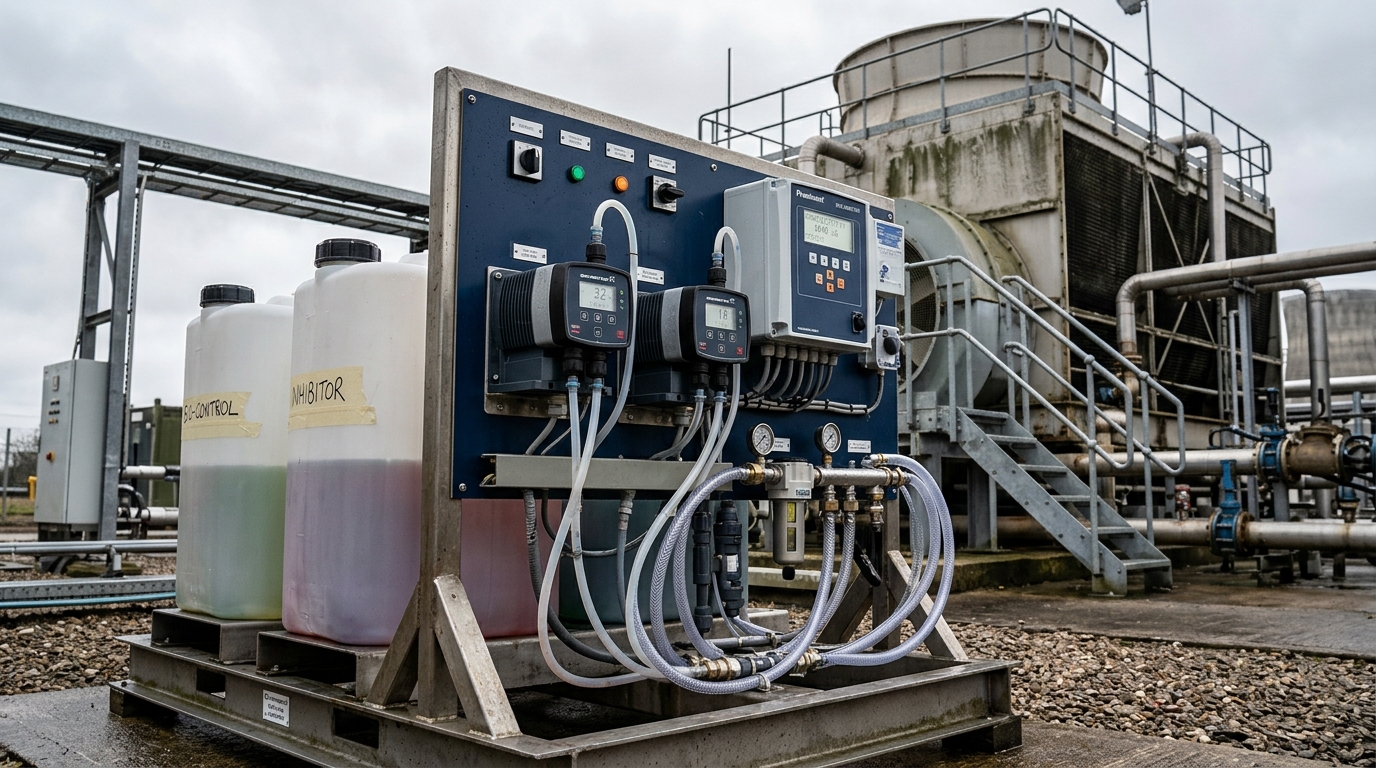
Cooling Tower Water Treatment: Biocides, Bleed and Monitoring
Cooling tower water treatment is the combined programme of scale control, corrosion inhibition, biocide dosing and bleed control that keeps an evaporative cooling system clean enough to stop Legionella growing. HSE's technical guidance, HSG274 Part 1, sets out what that programme should achieve and how it should be checked.
Treatment is usually delivered by a specialist contractor, but the legal duty to control the risk stays with the dutyholder. This article explains the main elements of a programme, the routine checks HSG274 Part 1 describes, and what a Responsible Person should expect to see from their water treatment provider.
Why Cooling Tower Water Treatment Matters
Cooling towers and evaporative condensers combine warm water, nutrients picked up from the air and a spray or aerosol that can travel well beyond the site boundary. They have been linked to some of the largest Legionnaires' disease outbreaks in the UK and abroad, which is why they must be notified to the local authority under the Notification of Cooling Towers and Evaporative Condensers Regulations 1992. Our guide to cooling tower Legionella control and notification covers those duties in more detail.
The legal framework is the same as for any other water system: the Health and Safety at Work etc. Act 1974, the Control of Substances Hazardous to Health Regulations 2002 (COSHH) and the Approved Code of Practice (ACOP) L8. The practical detail is in HSG274 Part 1, which HSE updated in a second edition in 2024. The treatment programme should be built on a current BS 8580-1 compliant risk assessment and written into the site's control scheme.
Scale and Corrosion Control
As water evaporates, dissolved salts concentrate in the system. Scale forms more readily as calcium levels, pH, temperature and total dissolved solids rise. Scale shelters bacteria and reduces the effect of biocides, so a programme that only adds biocide rarely stays in control for long.
HSG274 Part 1 lists several ways to control scale, often used together:
softening the make-up water
dosing a specific scale inhibitor
acid dosing to reduce alkalinity
limiting how far the water is allowed to concentrate
Corrosion matters for Legionella control too, because corrosion products can encourage bacterial growth. The guidance says corrosion of mild steel should be inhibited and that inhibitors should be applied continuously, commonly by a dosing pump linked to a water meter on the make-up supply. It gives a general corrosion target of less than 5 mpy (mils per year), and preferably less than 2 mpy. Oxidising biocides increase corrosion if overdosed, so dosing points should keep biocide and inhibitor apart until both are well diluted.
Biocides: Oxidising and Non-Oxidising
Most programmes rely on an oxidising biocide, usually chlorine- or bromine-based, dosed continuously or controlled by a redox or amperometric system. If shot dosing is used, it has to be frequent enough to keep control at all times, not just after each dose.
HSG274 Part 1 gives typical free halogen reserves, measured by the DPD No 1 method:
Chlorine: 0.5 to 1.0 mg/l as Cl2
Bromine: 1.0 to 2.0 mg/l as Br2
The 2024 edition added that DPD No 1 results should be corrected for pH. As pH rises, the active hypochlorous and hypobromous acids convert to far less effective forms, so a reading that looks satisfactory can hide weak biocidal activity in high-pH water. We explain the chemistry, and why bromine programmes in hard, alkaline water need particular care, in free bromine in cooling towers: why total bromine isn't enough. The guidance also expects target reserves to be adjusted where monitoring and Legionella results show that control is not effective.
Non-oxidising biocides are normally shot dosed, usually with a contact time of at least four hours. Where they are used, HSG274 Part 1 recommends alternating two products with different modes of action so that the microbial population does not become tolerant to either one.
Bleed and Cycles of Concentration
Bleed (also called blowdown) removes concentrated system water and replaces it with fresh make-up water. It is what stops dissolved solids building up beyond the point the scale and corrosion programme can handle. The ratio between the system water and the make-up water is the concentration factor, or cycles of concentration, and HSG274 Part 1 expects it to be calculated as part of monthly monitoring.
Bleed is usually controlled automatically by a conductivity controller. If the sensor drifts or the bleed valve sticks, the water chemistry can move out of range within a short timeframe. HSG274 Part 1 suggests checking conductivity sensor calibration and the blowdown function every one to three months, according to risk. Where a system is out of use for a week or more, biocide should still be dosed and circulated at least weekly.
Monitoring Cooling Tower Water Treatment
HSG274 Part 1 sets out typical monitoring frequencies, which can be added to or reduced depending on the system. For the cooling system water these include:
Oxidising biocide residual: weekly
pH: weekly
Conductivity or total dissolved solids: weekly
Microbial activity (dip slide or total viable count): weekly
Calcium or total hardness, total alkalinity, chloride, total iron and inhibitor level: monthly
Concentration factor and calcium balance: monthly (calculated)
Legionella: at least quarterly
The guidance gives action levels for aerobic counts. Up to 10,000 cfu/ml indicates the system is under control. Between 10,000 and 100,000 cfu/ml calls for a review of the programme and a resample. Above 100,000 cfu/ml calls for corrective action, such as shot dosing or increased biocide dosing, and a resample. Biocide samples should be taken away from the dosing point and, where possible, when the residual is at its lowest, at the same time each week.
Legionella results are assessed against separate action levels for counts above 100 cfu/l and above 1,000 cfu/l. HSG274 Part 1 notes that occasional positives are not unusual, but repeated positives, or positives alongside poor biocide control or high counts, should be investigated. More frequent sampling may be needed after a positive result or when commissioning a system or a new treatment programme.
Readings only help if someone reviews them against trends, not just against limits. Biocide reserves are most useful read alongside pH, and both are most useful read alongside dip slide and Legionella results.
What to Expect From Your Water Treatment Contractor
HSG274 Part 1 is clear that contractors have legal responsibilities of their own, but the dutyholder keeps ultimate responsibility for safe operation. The Responsible Person for Legionella control should expect:
Agreed control parameters: target ranges for each parameter, agreed between the site and the provider and recorded in the written control scheme.
Clear test methods: how biocide is measured, including pH correction of DPD No 1 results.
Monthly service reports: results against targets, trends, dosing changes and any equipment faults.
Defined responses: what happens when a result goes out of range, who is told and how quickly.
Joint review: HSG274 Part 1 expects the Responsible Person and the provider to review results together and agree actions.
Competent staff: trained service technicians and evidence of their competence.
Key Points
Cooling tower water treatment combines scale control, corrosion inhibition, biocide dosing and bleed control.
HSG274 Part 1 (2024) gives typical reserves of 0.5 to 1.0 mg/l chlorine or 1.0 to 2.0 mg/l bromine, and DPD No 1 results should be pH-corrected.
Biocide, pH, conductivity and microbial counts are typically checked weekly, with Legionella sampling at least quarterly.
Bleed controllers and conductivity sensors need regular checks, every one to three months according to risk.
Control parameters should suit the actual system and be adjusted when results show control is not effective.
The contractor delivers the programme, but the dutyholder remains responsible for it.
Frequently Asked Questions
How often should cooling tower water be tested?
HSG274 Part 1 gives typical frequencies: weekly for biocide residual, pH, conductivity and microbial counts, monthly for hardness, alkalinity, chloride, iron and inhibitor, and at least quarterly for Legionella. These can be adjusted to suit the system and its risk assessment.
What is a good biocide level in a cooling tower?
HSG274 Part 1 gives typical free halogen reserves of 0.5 to 1.0 mg/l as chlorine or 1.0 to 2.0 mg/l as bromine. Results should be pH-corrected, and targets should be raised if monitoring shows control is not being achieved.
Who is responsible if the water treatment contractor gets it wrong?
The contractor has its own legal duties, but the dutyholder keeps overall responsibility. That is why the Responsible Person should review results with the contractor and make sure problems are acted on.
References and Further Reading
HSE, HSG274 Part 1: The control of legionella bacteria in evaporative cooling systems (second edition, 2024)
HSE, ACOP L8: Legionnaires' disease. The control of legionella bacteria in water systems (fourth edition, 2013)
The Notification of Cooling Towers and Evaporative Condensers Regulations 1992
The Control of Substances Hazardous to Health Regulations 2002
A good water treatment programme is not a set of fixed numbers. It is a cycle of dosing, testing, reviewing and adjusting, with the dutyholder engaged throughout.

Andrew Arnold
Co‑founder & Director
Andrew has over 20 years' experience in Legionella management and control. As a senior member of the Water Management Society and educated to masters level Andrew has extensive experience in legionella risk assessment of numerous systems and sectors.