Legionella Sampling: When Is It Needed and What Do the Results Mean?
Legionella sampling is not routinely required for most mains-fed hot and cold water systems. HSE guidance instead advises it for specific circumstances including: where biocides are used in place of full temperature control, where control levels are not being consistently achieved, in high-risk settings such as healthcare and care homes, and when a system is linked to a case or outbreak of Legionnaires' disease.
Where sampling is carried out, it is only useful if it is planned around the risk assessment, taken to a recognised method and analysed by a competent laboratory, with the response to each result agreed in advance. This article explains when sampling is appropriate, how to do it and how to read the results against HSG274 Part 2.
Is Legionella Sampling a Legal Requirement?
There is no blanket legal requirement to sample hot and cold water systems for Legionella. The legal duties under the Health and Safety at Work etc. Act 1974 and Control of Substances Hazardous to Health Regulations 2002 (COSHH) are to assess the risk and to prevent or control exposure. The Approved Code of Practice (ACOP) L8 explains how to meet those duties, and HSG274 Part 2 gives the technical detail for hot and cold water systems.
The HSE's own guidance on testing and monitoring your water system is clear that, because hot and cold water systems are generally enclosed, significant contamination is less likely than in open systems such as cooling towers, so microbiological monitoring is not usually required. Control is demonstrated primarily through temperature checks, flushing and inspection. Sampling is no substitute for the basics covered in temperature monitoring in Legionella control.
When Legionella Sampling Should Be Carried Out
HSG274 Part 2 identifies the following situations as examples of where sampling for Legionella should be considered:
Biocide-treated systems with reduced temperatures. Where a system is controlled by a biocide such as chlorine dioxide or silver/copper ionisation and storage or distribution temperatures are lower than those normally recommended, initial testing is advised monthly to give early warning of loss of control, until there is confidence in the regime.
Control levels not consistently achieved. Where temperatures or biocide concentrations are falling short of the targets, more frequent testing, for example weekly, is advised while the cause is investigated and corrected.
High-risk settings. Where occupants are at increased risk, such as healthcare premises and care homes.
Suspected or confirmed cases. Where a system is suspected or identified as the source in a case or outbreak of legionellosis, working with the local authority and UKHSA.
Sampling is also commonly used to confirm the effectiveness of a disinfection. HSG274 Part 2 advises that samples to confirm effective disinfection should be taken between two and seven days after the system is refilled, because samples taken immediately afterwards can give false negative results.
Healthcare premises should also follow NHS England's HTM 04-01 Safe water in healthcare premises.
How Samples Should Be Taken
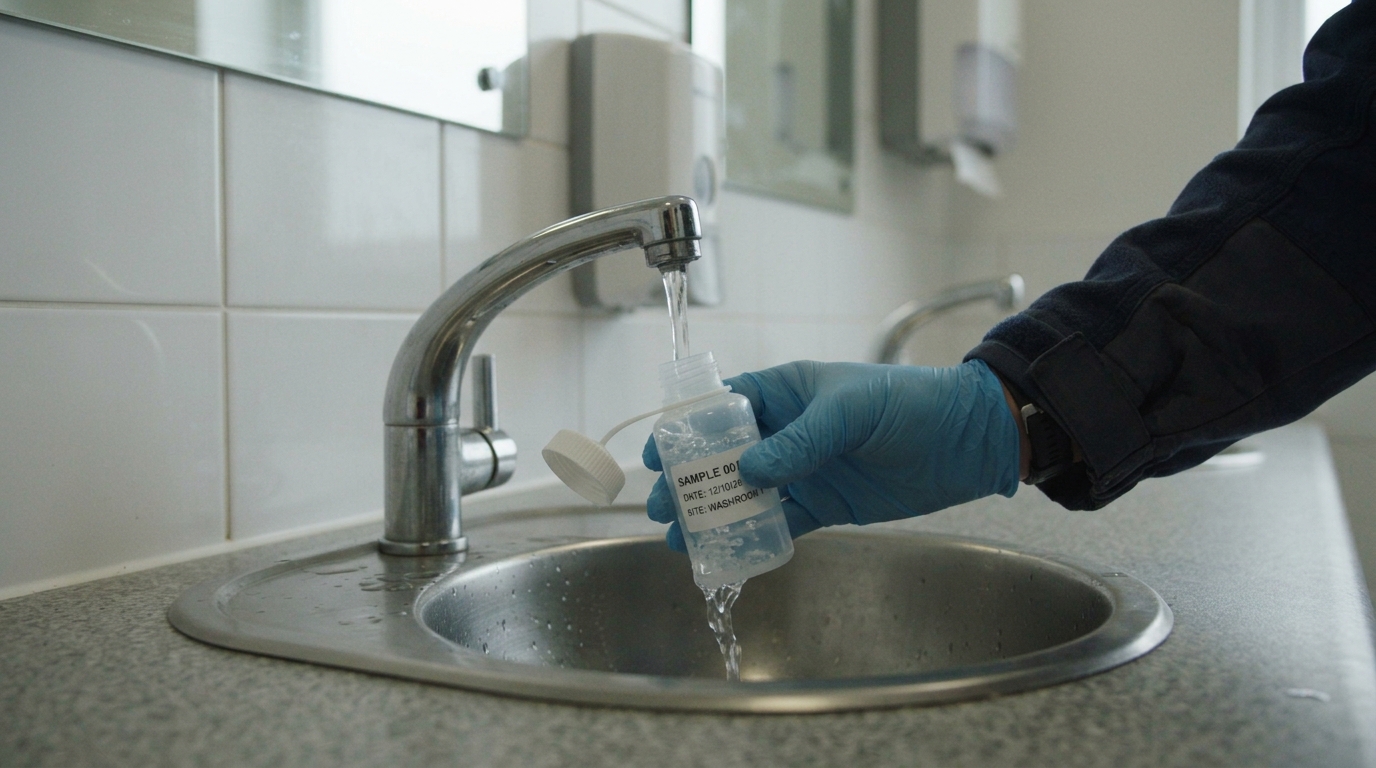
Sampling should follow BS 7592:2022 Sampling for Legionella bacteria in water systems, with any biocide neutralised where possible. The sampler needs to understand what question each sample is answering.
Pre-flush and post-flush samples
Pre-flush samples are taken from the first water drawn from an outlet. They show conditions at the outlet itself, including the tap or fitting and the water standing in the pipework just behind it. This is closest to what a user would be exposed to.
Post-flush samples are taken after the outlet has been run for a period. They are more representative of the water in the wider distribution system.
Comparing the two helps locate a problem: a positive pre-flush result with a clear post-flush result points to the outlet or its local pipework, while positives in both suggest a wider system issue. Label each sample with its source and whether it was pre- or post-flush.
Where to sample
Sampling points should be chosen from the risk assessment and schematic, not at random. HSG274 Part 2 points towards:
areas where control parameters are not being met, such as hot water below 50°C (55°C in healthcare premises) or cold water above 20°C
low-use outlets, deadlegs and areas of stagnation or excess storage
near and far sentinel outlets on each branch of the cold water system, and the point of entry where the supply is private or the incoming water is above 20°C
the calorifier hot water outlet (and the base, where it is safe to do so), plus near and far sentinel outlets on each hot water loop or single-pipe branch
Samples should be taken from separate hot and cold outlets rather than mixer taps, or outlets downstream of thermostatic mixing valves or showers, so that the result can be traced to a particular part of the system.
Choosing a Laboratory
A result is only as reliable as the laboratory producing it. HSE guidance says water samples should be tested by a UKAS-accredited laboratory that holds the relevant Legionella methods within its scope and takes part in a water microbiology proficiency testing scheme, such as that run by UKHSA. For culture methods, the laboratory should apply a detection limit of no more than 100 Legionella bacteria per litre.
Interpreting Legionella Sampling Results
Results are reported in colony-forming units per litre (cfu/l). HSG274 Part 2 (Table 2.2) sets out the action to take when Legionella is found in a hot and cold water system:
More than 100 cfu/l and up to 1,000 cfu/l: if only a minority of samples are positive, resample. If a similar count is found again, review the control measures and the risk assessment to identify remedial actions. If the majority of samples are positive, the system may be colonised, albeit at a low level; carry out an immediate review of control measures and the risk assessment, and consider disinfection.
More than 1,000 cfu/l: resample and carry out an immediate review of the control measures and risk assessment to identify remedial actions, including possible disinfection of the system.
A positive result is a symptom, not a diagnosis. The response should always ask why control has failed: temperatures, flow, stagnation, storage capacity or the condition of outlets.
Responding to a Positive Result
A pre-agreed response plan in the written control scheme avoids delay and guesswork. A typical sequence is:
Inform the Responsible Person and record the result, the sample locations and the date.
Review the monitoring records for the affected area: temperatures, flushing and any recent works.
Take immediate local measures where appropriate, such as restricting use of an outlet, cleaning and disinfecting fittings, or increasing flushing. Our guide to correct flushing procedures covers how to do this properly.
Review the control measures and the risk assessment, and correct the underlying cause.
Resample to confirm the actions have worked, and continue sampling at an increased frequency until confidence is restored.
All sampling results, actions and follow-up results should be kept with your other Legionella records. HSE's guidance on keeping records says records of monitoring and inspection should be retained for at least five years.
Key points
Legionella sampling is not routinely needed for most mains-fed hot and cold water systems; temperature control and flushing are the primary evidence of control.
Sample where biocides replace full temperature control, where control levels are not being met, in high-risk settings, and when investigating cases.
Follow BS 7592:2022, distinguish pre-flush from post-flush samples, and choose locations from the risk assessment.
Use a UKAS-accredited laboratory that takes part in a proficiency testing scheme.
Results above 100 cfu/l call for resampling and review; above 1,000 cfu/l calls for an immediate review of control measures and the risk assessment.
Investigate why control was lost, and keep results and actions for at least five years.
Frequently asked questions
How often should you test for Legionella?
For most hot and cold water systems controlled by temperature, routine testing is not required. Where a system relies on a biocide with reduced temperatures, HSG274 Part 2 advises monthly testing initially. Where control levels are not being met, more frequent testing, for example weekly, is advised until control is restored.
What is an acceptable Legionella count?
HSG274 Part 2 sets action levels rather than a "safe" level. Counts above 100 cfu/l should trigger resampling and a review, and counts above 1,000 cfu/l an immediate review of the control measures and risk assessment. Any detection in a high-risk setting such as healthcare should be discussed with the water safety group.
Can I use a home Legionella test kit?
HSE guidance expects samples to be analysed by a UKAS-accredited laboratory that participates in a proficiency testing scheme. On-site kits may be a useful extra indicator but should not replace accredited analysis.
Does a negative result mean the system is safe?
No. A negative result shows Legionella was not detected in that sample at that time. It does not replace temperature monitoring, flushing and inspection, which remain the main evidence that the system is under control.
References and further reading
HSE, Testing and monitoring your water system for legionella
HSE, HSG274 Part 2: The control of legionella bacteria in hot and cold water systems
BSI, BS 7592:2022 Sampling for Legionella bacteria in water systems. Code of practice
HSE, Keeping records
NHS England, HTM 04-01 Safe water in healthcare premises
Planned around the risk assessment, taken to BS 7592 and backed by an agreed response, sampling gives early warning when control is slipping. For how it fits within the wider assessment, see our article on BS 8580-compliant Legionella risk assessments.

Andrew Arnold
Co‑founder & Director
Andrew has over 20 years' experience in Legionella management and control. As a senior member of the Water Management Society and educated to masters level Andrew has extensive experience in legionella risk assessment of numerous systems and sectors.