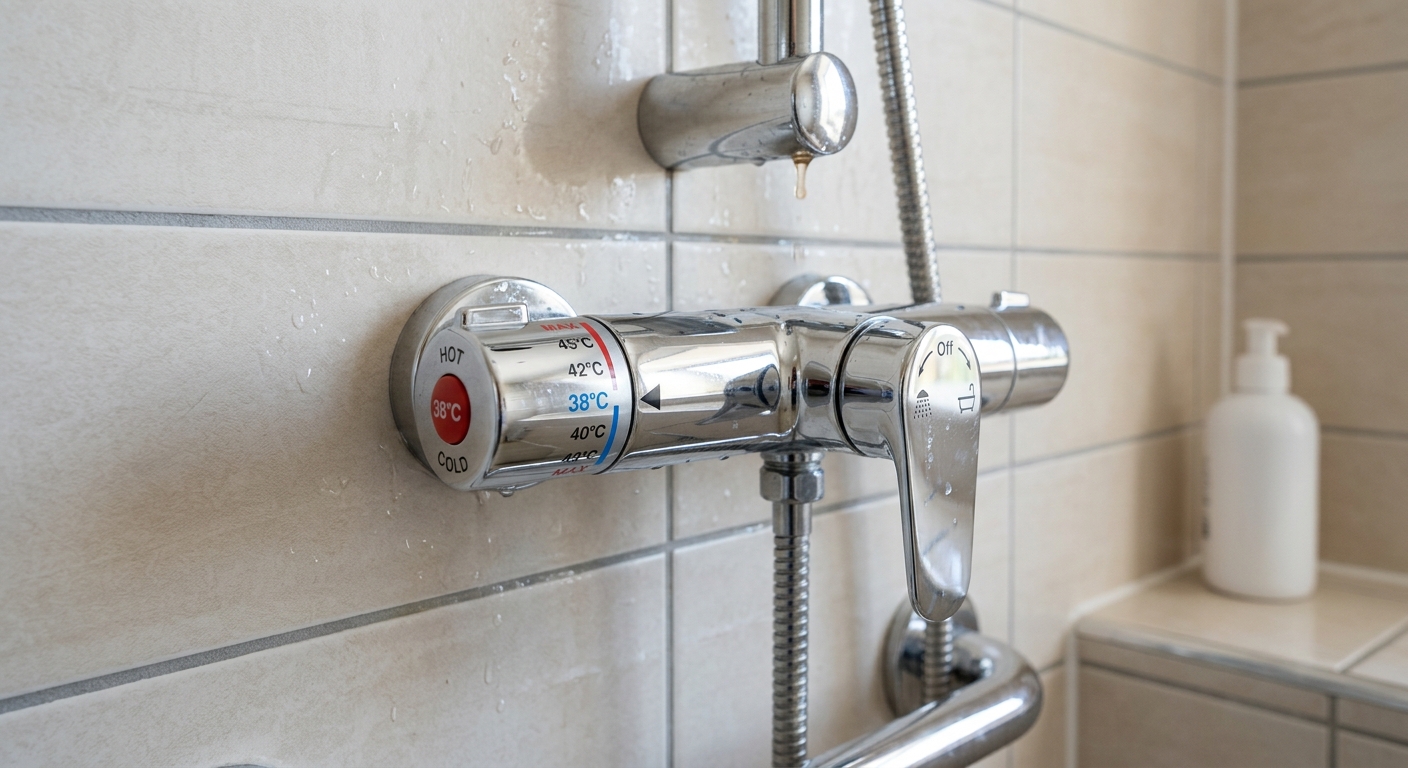
Thermostatic Mixing Valves: Balancing Scalding and Legionella Risk
A thermostatic mixing valve (TMV) blends hot and cold water to deliver a safe outlet temperature, protecting users from scalding but leaving warm water downstream that can support Legionella growth. Managing thermostatic mixing valve Legionella risk means fitting TMVs only where the risk assessment shows they are needed, setting them to the right blended temperature, siting them close to the outlet, and keeping them maintained and regularly used.
TMVs sit where two duties meet: hot water must be hot enough to control Legionella, yet at the outlet it can seriously injure a vulnerable user. This article sets out how HSE guidance and healthcare guidance HTM 04-01 expect that balance to be struck.
Why TMVs Are Needed in Temperature-Controlled Systems
Where temperature is the control strategy, HSG274 Part 2 says hot water should be stored at a minimum of 60°C and distributed so that it reaches at least 50°C within one minute at outlets, or 55°C in healthcare premises. HTM 04-01 Part B sets the same 55°C expectation. Water at these temperatures controls Legionella growth but can scald the very young, older people, disabled people and those with sensory loss. A TMV lets the system stay hot while the user receives water at a safe blended temperature.
Recommended Blended Temperatures Under HTM 04-01
HSG274 Part 2 does not give a blended temperature for each outlet type. The figures most widely used come from HTM 04-01 guidance and corresponding supplement, Performance specification D 08: thermostatic mixing valves (healthcare premises), 2017 edition. D 08 is the specification Type 3 (TMV3) valves are tested against, and it sets these maximum mixed water temperatures:
Bidet: 38°C
Shower: 41°C
Washbasin: 41°C (D 08 assumes hands are washed under running water)
Bath, standard fill: 44°C
Bath, assisted fill: 46°C
Combined bath and shower: bath fill as above, shower 41°C
These are maximums, not targets. The setting for each outlet should reflect the scalding risk assessment for its users and be recorded at commissioning, so later checks can show any drift.
The 46°C bath fill and HSE's 44°C limit
The 46°C figure often causes confusion, because HSE's guidance on scalding and burning in health and social care states that where vulnerable people are at risk during whole-body immersion, water temperatures must not exceed 44°C. The two fit together. HTM 04-01 Part B explains that for assisted bathing the delivery temperature may need to be set higher than would normally be considered safe, because a large bath loses heat as it fills. D 08 adds that bath fill temperatures above 44°C should only be available where the bather is always supervised by a competent person.
The safeguard is the check before bathing: HTM 04-01 Part B states that the water must be checked with a thermometer before a patient is placed or helped into the bath, to confirm it has fallen to a safe value. Where 46°C fills are used, keep a reliable thermometer at each assisted bath and a written procedure staff follow every time.
Applying HTM 04-01 outside healthcare settings
HTM 04-01 is written for healthcare provision premises in England, with equivalents in Scotland and Wales. It is designed for use in the healthcare sector but aspects of this guidance, specifically around scald risk and use of thermostatic mixing valves, including blended outlet discharge temperatures, are commonly adopted in non-healthcare settings. The written control scheme should name the standard adopted and record each outlet's set temperature.
Where Thermostatic Mixing Valves Should Be Fitted
The decision to fit a TMV should come from a scalding risk assessment, not from habit. HSG274 Part 2 states that where the risk of scalding is assessed as insignificant, TMVs are not required, and HTM 04-01 Part B confirms that the scalding risk assessment decides both whether a device is needed and what type. Fitting them everywhere "to be safe" adds blended pipework without a corresponding benefit.
Baths and showers: HSE expects TMVs where vulnerable people may be immersed and water could otherwise exceed 44°C.
Washbasins: HSE notes the risk is much lower without whole-body immersion, but TMVs should be fitted where users are assessed as vulnerable.
Workplaces with healthy adult users: a hot water warning notice at washbasins may be sufficient.
Type 2 and Type 3 valves
HSG274 Part 2 distinguishes Type 2 valves, suitable where the scalding risk is low, from Type 3 valves, which fail-safe, meaning a disruption in the cold supply to the valve shuts off the blended discharge from the valve to prevent raw hot water from being discharged at potentially scalding temperatures. Type 3 valves should be provided where the risk is significant and in healthcare premises. In practice, Type 3 means a valve approved to D 08 under the TMV3 scheme. HTM 04-01 Part B also advises against installing TMVs in series with mixing taps.
Thermostatic Mixing Valve Legionella Risk From Blended Water
Blended water is, by design, in or close to the temperature range in which Legionella multiplies. HSG274 Part 2 and HTM 04-01 Part B both warn that blended water downstream of TMVs can let Legionella multiply. The risk increases with:
Long blended runs from remote or concealed valves.
One TMV serving several outlets, which D 08 advises against where the downstream deadleg may increase bacterial growth.
Low-flow spray taps, through low throughput and aerosol.
Little-used outlets, which behave much like deadlegs.
Scale and debris in valves, strainers and filters.
The design answer is to minimise blended water: HSG274 Part 2 prefers TMVs built into the tap fitting or, failing that, as close to the outlet as possible. Remove unneeded valves, cut back redundant pipework and keep remaining valves accessible. TMVs also need hot and cold supplies at their proper temperatures to blend accurately; our article on the Legionella threat in hot water recirculating systems explains how distribution problems develop.
Maintenance, In-Service Testing and Monitoring
Table 2.1 of HSG274 Part 2 expects TMVs to be maintained by competent persons, with strainers and filters inspected, cleaned, descaled and disinfected, annually or at a frequency set by the risk assessment and the manufacturer's recommendations. HTM 04-01 Part B points to D 08 for the testing method:
Commissioning: record each valve's set mixed temperature and supply temperatures.
Fail-safe test: isolate the cold supply and confirm the valve shuts off. D 08 calls for further investigation if more than 120 ml is collected over 60 seconds. Follow the manufacturer's method so the test does not itself create a scald risk.
In-service tests: D 08 flags any valve whose mixed temperature has moved more than 2°C from its commissioned setting.
Test frequency: TMV3 scheme guidance suggests the first in-service test 6–8 weeks after commissioning and the second at 12–15 weeks, with later intervals based on how stable each valve proves to be.
Using and monitoring TMV outlets
HSG274 Part 2 recommends weekly flushing of little-used outlets; HTM 04-01 Part B lets the water safety group set a higher frequency in healthcare, with outlet use built into daily cleaning. See our guide to correct flushing procedures for Legionella control for practical method.
Monthly sentinel checks should show that supplies reaching each valve are at temperature and that blended temperatures sit at or below the set maximum. Our article on the importance of temperature monitoring in Legionella control explains how to build a reliable regime. If Legionella sampling is carried out, HSG274 Part 2 advises sampling separate hot and cold outlets rather than through mixer taps or outlets downstream of TMVs.
Key Points
HTM 04-01's D 08 specification sets the maximums most providers adopt: 38°C bidets, 41°C showers and washbasins, 44°C baths and 46°C supervised assisted bath fills.
Check any bath filled above 44°C with a thermometer before bathing; HSE's 44°C limit for whole-body immersion still applies.
Fit TMVs only where the scalding risk assessment shows a need, using Type 3 valves where the risk is significant and in healthcare.
Blended water can support Legionella growth: keep it to a minimum, flush little-used outlets, test valves in service and record every check.
Frequently Asked Questions
What temperature should water be after a TMV?
Under HTM 04-01's D 08 specification, the maximums are 38°C for bidets, 41°C for showers and washbasins, 44°C for a standard bath fill and 46°C for a supervised assisted bath fill. Each outlet's setting should come from the scalding risk assessment.
Why does HTM 04-01 allow 46°C when HSE says 44°C?
46°C is a fill temperature for large assisted baths, which lose heat as they fill. The bather must be supervised and the water checked with a thermometer before bathing, so nobody is immersed above a safe temperature.
How often should TMVs be tested?
HSG274 Part 2 indicates annual maintenance, or a frequency set by the risk assessment and the manufacturer. For Type 3 valves, TMV3 scheme guidance suggests tests at 6–8 and 12–15 weeks after commissioning, then intervals based on drift.
References and Further Reading
HSE, HSG274 Part 2: Legionnaires' disease – The control of legionella bacteria in hot and cold water systems
HSE, Approved Code of Practice (ACOP) L8: Legionnaires' disease – The control of legionella bacteria in water systems
NHS England, HTM 04-01: Safe water in healthcare premises, Parts A and B (2016)
NHS England, HTM 04-01 Supplement: Performance specification D 08: thermostatic mixing valves (healthcare premises) (2017)
HSE, Scalding and burning in health and social care
TMV3 scheme guidance for installation, commissioning and in-service testing of Type 3 valves
TMVs answer a real hazard, but they move part of the Legionella risk to the last metre of pipework. Treat each valve as a component that needs a reason to exist, a recorded set temperature, a sensible location, regular use and documented testing. If you have questions about your premises, our frequently asked questions page is a good place to start.

Andrew Arnold
Co‑founder & Director
Andrew has over 20 years' experience in Legionella management and control. As a senior member of the Water Management Society and educated to masters level Andrew has extensive experience in legionella risk assessment of numerous systems and sectors.